The Real Cost of Garage Bike Storage
In most homes, the garage is the most underutilized square footage in the entire property. As an energy efficiency advisor, I often see garages so cluttered with bicycles and gear that homeowners can't even fit their cars inside. This leads to vehicles sitting in the driveway, exposed to the elements, which can actually impact your car's efficiency and longevity. Moving your bicycles to the wall is one of the most cost-effective ways to reclaim that space.
From experience, the real issue usually isn't a lack of space, but a lack of organization. Storing bicycles on the floor takes up roughly 10 to 15 square feet per bike when you account for the leaning angle and handlebar width. By moving to a bike wall mount, you reduce that footprint to nearly zero floor space. In this guide, I will break down the costs and practicalities of the most popular hanging bikes solutions available today.
Simple Hooks and Claws: The Budget Option
The most basic way to achieve vertical bike storage is a simple vinyl-coated screw-in hook. You can find these at any hardware store for under $5. However, what works best isn't always the cheapest option at face value. While a single hook is inexpensive, it requires you to lift the entire weight of the bike and hook the front rim perfectly.
Pros of Hooks
- Lowest possible entry cost.
- Easily replaceable if they bend.
- Takes up the least amount of wall space when not in use.
Cons of Hooks
- Difficult for children or shorter adults to use.
- Requires a solid wood stud for installation; drywall anchors will fail.
- Can put stress on the wheel rims if the bike is heavy.
Cost Breakdown: Expect to spend $5 to $15 per bike for the hardware. If you are not comfortable finding studs, a handyman might charge $50 to $100 for a quick installation of several hooks.
Horizontal Bike Racks: The Display Choice
A garage bicycle rack that holds the bike horizontally by the frame is a common choice for people with high-end road bikes or cruisers. These racks keep the bike parallel to the wall. One thing many people overlook with horizontal mounts is the "handlebar stick-out." A standard mountain bike has handlebars roughly 700mm wide. If you hang it horizontally, that bike still protrudes nearly 30 inches into your walking path.
Pros of Horizontal Mounts
- Distributes weight evenly across the frame.
- Easier to lift the bike just a few feet off the ground.
- Often includes a small shelf for helmets and shoes.
Cons of Horizontal Mounts
- Uses a massive amount of horizontal wall real estate.
- Inefficient for families with four or more bikes.
- Incompatible with some full-suspension mountain bikes with odd frame shapes.
Cost Breakdown: Basic metal arms start at $20. Stylized wooden or minimalist mounts for living-room-quality display can reach $150. A solid middle-ground steel rack usually costs about $45.
Vertical Track Systems: High-Density Storage
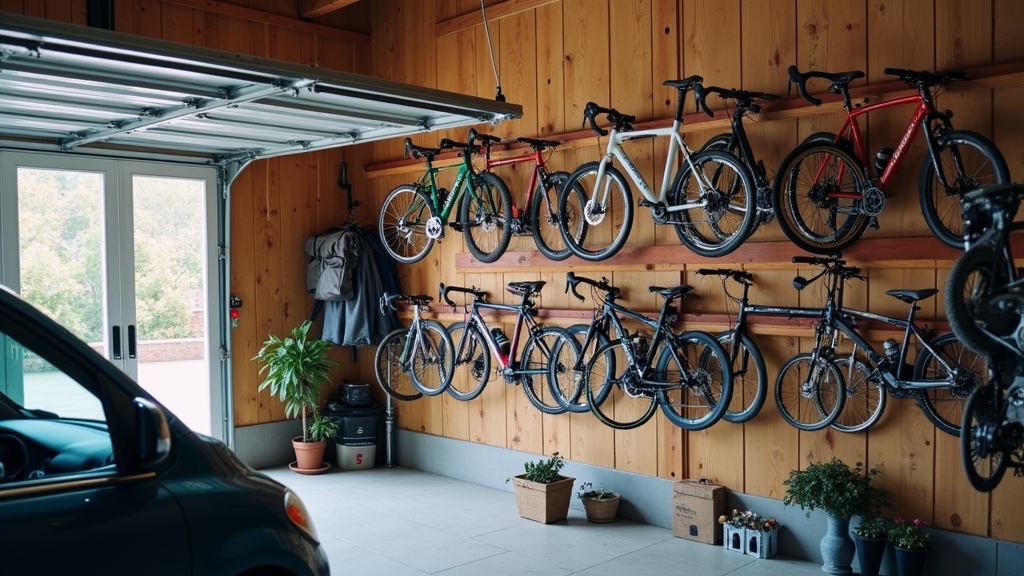
For those managing a fleet of family bikes, a vertical garage bicycle rack system is the gold standard. These systems involve a horizontal rail mounted to the wall, with individual hooks that slide along the rail. This allows you to overlap handlebars by staggering the height of the bikes.
Pros of Track Systems
- Allows you to store 5 bikes in the space normally required for 3.
- Highly adjustable as your kids grow or you change bike types.
- Installation is simpler because you only need to level one rail.
Cons of Track Systems
- Higher initial investment.
- Bikes can bang into each other if not spaced correctly.
- Requires significant vertical wall height.
Cost Breakdown: A 4-bike rail system typically costs between $80 and $120. This averages out to about $25 to $30 per bike, which is excellent value for the organization it provides.
Pivoting Vertical Mounts: The Premium Solution
In my experience, the most user-friendly vertical bike storage is the pivoting wall mount, such as the Steadyrack. These mounts allow you to roll the front tire into a cradle without lifting the bike. Once the bike is in the rack, you can swing it flat against the wall like a page in a book. This is a game-changer for narrow garages where a car needs to fit next to the bikes.
Pros of Pivoting Mounts
- No heavy lifting required; you balance the bike on the rear tire and roll it in.
- Allows for extremely tight storage while still maintaining access.
- Ideal for heavy e-bikes (up to 75 lbs).
Cons of Pivoting Mounts
- The most expensive per-bike option.
- Requires a large amount of wall height for the pivot arm.
- Installation takes more time per unit.
Cost Breakdown: These units typically cost $70 to $90 per bike. For a family of four, you are looking at nearly $350 in hardware alone.
Installation and Safety Considerations
The key thing to remember when hanging bikes is that a standard drywall wall is not designed to hold 30 to 50 pounds of concentrated weight. You must secure your mounts into the wall studs. Over the years, I have learned that many DIY failures happen because people use the wrong screws. Always use 2-inch or 2.5-inch lag screws or heavy-duty wood screws. Avoid using the small screws that sometimes come in the box with cheap imported racks.
A common situation is having a finished garage with finished drywall. If your studs don't align where you want your bikes, here is what works best: mount a 2x4 or 1x6 piece of lumber horizontally across several studs using structural screws. Then, mount your bike racks directly to that lumber. This creates a "mounting plate" that is incredibly secure and allows you to space the bikes exactly where you want them, regardless of stud location.
Final Recommendation by Situation
To help you decide, I have categorized the best choices based on common household needs:
- The Budget DIYer: Use heavy-duty $5 vinyl hooks screwed directly into the ceiling joists or wall studs. Total cost: ~$20 for 4 bikes.
- The Family of Four: Use a horizontal track system like the Monkey Bar or Gladiator. It grows with the family. Total cost: ~$100.
- The E-Bike Owner: Use a pivoting vertical mount. E-bikes are too heavy for most people to lift onto high hooks safely. Total cost: ~$85 per bike.
- The Small Garage Owner: Use the pivoting mount. The ability to swing the bikes flush against the wall is the only way to fit a car and bikes in a standard single-car garage.
Conclusion
Investing in vertical bike storage is about more than just cleaning up a mess. It protects your equipment and makes it easier to choose a bike over a car for short trips, which is a core principle of energy-efficient living. While the $5 hook is tempting, most homeowners find that a $30-$50 investment per bike provides a much safer and more convenient experience over the long term. Measure your wall, count your bikes, and choose the system that matches your physical ability to lift the weight of your heaviest bicycle.