I have spent 15 years renovating kitchens and wrestling with the same frustrating problem: the deep corner cabinet. It is the place where plastic lids go to die and heavy Dutch ovens disappear for years. Most homeowners call these "dead corners" for a reason. Here is the thing: that space is actually valuable real estate if you use the right hardware.
The Corner Cabinet Conundrum
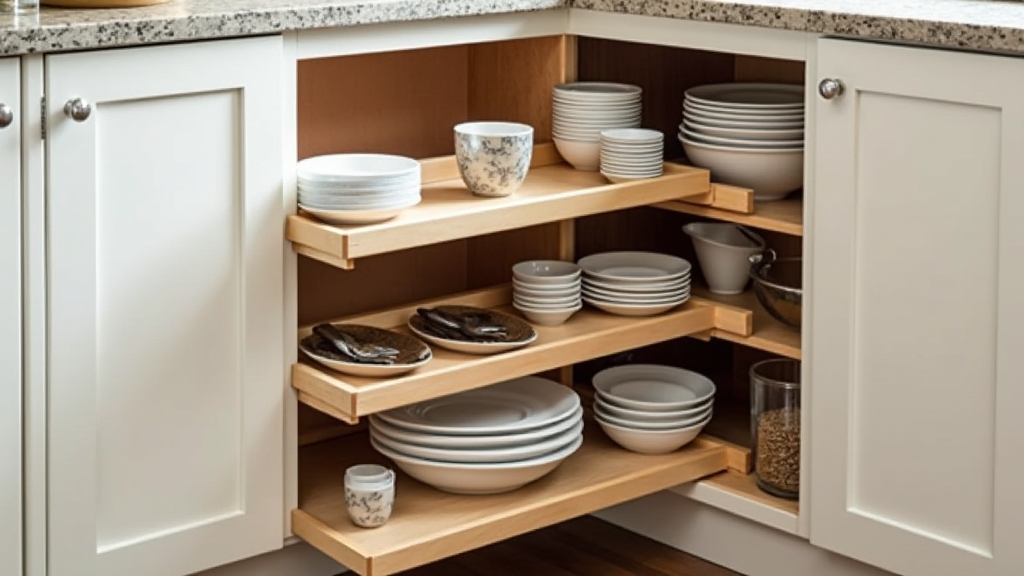
When you design a kitchen, corners are inevitable. You usually end up with either a L-shaped corner or a blind corner cabinet. A blind corner is where one cabinet hides behind the face of another, creating a deep, dark cavern that is nearly impossible to reach into without crawling on your hands and knees. Over the years, I have installed dozens of different organizers to fix this. Now, the important part is choosing a solution that fits your specific workflow and budget.
The Classic Lazy Susan
The Lazy Susan is the oldest trick in the book. It consists of rotating circular or kidney-shaped trays mounted on a central pole. While many modern designers dismiss them as old-fashioned, they still serve a purpose in specific layouts.
Pros of Lazy Susans
- Low cost compared to mechanical pull-out systems.
- Simple installation that most DIYers can handle in an hour.
- Provides 360-degree access to items.
Cons of Lazy Susans
- Items can fly off the shelves and get stuck behind the mechanism.
- The circular shape leaves the actual corners of the cabinet empty.
- Weight limits are often lower than heavy-duty alternatives.
Something to keep in mind: if you go this route, look for a "Super Susan." These are trays mounted on fixed shelves with ball-bearing swivels rather than a center pole. They are much sturdier and do not wobble when you load them with heavy canned goods.
The Swing-Out Cloud or Kidney Shelf
This is where it gets interesting. These units, often called "LeMans" units due to their shape, feature two independent shelves that swing entirely out of the cabinet. They are designed specifically for blind corners where a traditional circle won't fit.
Pros of Swing-Out Shelves
- The shelves come to you, so you never have to reach into the cabinet.
- They handle significant weight, often up to 55 lbs per shelf.
- The curved shape allows for larger pots and pans.
Cons of Swing-Out Shelves
- The installation is significantly more complex and requires precise measurements.
- They are expensive, often starting at $300-$500 for quality hardware.
- The mechanism takes up some of the internal vertical space.
What most people miss is the "path of travel." Before you buy one, check if your oven handle or dishwasher sits right next to the corner. If the hardware swings out too far, it might hit your appliances.
The Blind Corner Pull-Out Optimizer
Often referred to as a "Magic Corner," this system uses a rectangular basket setup. When you pull the door, the front baskets swing out, and the back baskets slide forward into the opening. It is a masterpiece of engineering.
Pros of Pull-Out Optimizers
- Uses almost 90% of the available square footage in the cabinet.
- Rectangular baskets are better for organizing boxes and square containers.
- Heavy-duty rails provide smooth, soft-close movement.
Cons of Pull-Out Optimizers
- Extremely high cost (often $600+).
- Many moving parts mean more potential for mechanical failure over a decade of use.
- The complex frame makes cleaning the bottom of the cabinet difficult.
Cost Comparison and Value
Let's talk numbers. The good news is that there is a solution for every budget level. Here is a rough breakdown based on my experience with various hardware brands:
- Lazy Susan: $50 - $150. Best for those on a tight budget or those with standard L-shaped corners.
- Swing-Out Shelves: $250 - $450. Best for medium budgets and heavy cookware.
- Magic Corner Pull-Outs: $500 - $900. Best for high-end renovations where maximizing every inch is the priority.
- Custom Corner Drawers: $800+. These are built into the cabinetry itself and require a professional cabinet maker.
Best Use Cases for Each Option
Choosing the right hardware depends on what you plan to store. For example, if you are storing small spices and oils, a Lazy Susan is actually great because the spinning motion makes everything visible. On the other hand, if you need a home for your heavy Stand Mixer or a stack of cast iron skillets, the Swing-Out shelves are far superior because they don't have a center pole in the way.
I recently helped a friend who had a blind corner next to her sink. We installed a Pull-Out Optimizer. Worth mentioning is that she used the front baskets for daily cleaning supplies and the back baskets for seasonal items like her turkey roaster. This transformed a dead space into her most organized cabinet.
Final Recommendation
If you are a DIYer looking for the best balance of ease and function, I recommend the Swing-Out (LeMans) shelves. They are easier to install than the complex Magic Corners but offer a much more modern feel than the Lazy Susan. They solve the "reach-in" problem entirely and feel incredibly premium when they glide out. However, if you are working with a very narrow door opening (less than 15 inches), you might be forced to use a Lazy Susan or simple tiered organizers, as the mechanical units require a wider clearance to swing through.
Always measure your door opening twice. I have seen many homeowners buy a $400 unit only to realize it won't fit through the actual cabinet frame. Take your time, check your clearances, and stop letting that corner space go to waste.