In over a decade of designing landscapes, I’ve seen homeowners spend thousands on high-end appliances only to realize their layout makes cooking a chore rather than a pleasure. A successful BBQ area isn't just about the outdoor grill you choose; it’s about the infrastructure surrounding it. Whether you are working with a compact patio or an expansive stone terrace, the way you integrate your grilling station determines both your property value and your weekend enjoyment.
The Three Pillars of Outdoor Kitchen Design
Before we dive into the comparison, here is the thing: every professional setup relies on the 'Landing Zone' principle. You need at least 12 inches of heat-safe counter space on one side of the grill and 24 inches on the other. Now, the important part: wind direction. I have seen countless DIY setups that fail because the prevailing wind blows smoke directly into the dining area or, worse, back into the house through the sliding doors. Always position your grill so the wind carries smoke away from the guests.
Option 1: The Standalone Modular Cart
This approach utilizes high-quality portable grills—think Weber Summits or Napoleon Prestiges—paired with modular cabinetry or prep tables. It is the go-to for renters or those who want to invest in the appliance rather than the architecture.
Pros of Standalone Carts
- Flexibility: You can move the grill to account for seasonal sun angles or wind shifts.
- Maintenance: 360-degree access makes cleaning the manifold and replacing gas lines significantly easier.
- Portability: If you sell your home, the $3,000 grill goes with you.
Cons of Standalone Carts
- Aesthetics: It often looks like an afterthought rather than a designed space.
- Storage: You are limited to the cabinet space beneath the grill, which is usually consumed by the propane tank.
Option 2: The Prefabricated Island
This is where it gets interesting. Prefab islands are the middle ground. They arrive as a finished 'box'—usually made of glass-fiber reinforced concrete (GFRC) or galvanized steel frames—and are dropped onto your patio via a crane or dolly. You simply slide in the outdoor grill head and hook up the utilities.
Pros of Prefab Islands
- Speed: You can go from a bare patio to a full grilling station in four hours.
- Consistency: The finishes are factory-applied, meaning no crooked stones or grout issues.
- Weight: They are often lighter than masonry, making them safer for existing decks.
Cons of Prefab Islands
- Limited Customization: You are forced into specific dimensions and shapes (usually L-shaped or linear).
- Delivery Hurdles: If you don't have a 10-foot wide gate for equipment, the delivery cost can skyrocket.
Option 3: The Custom Masonry Kitchen
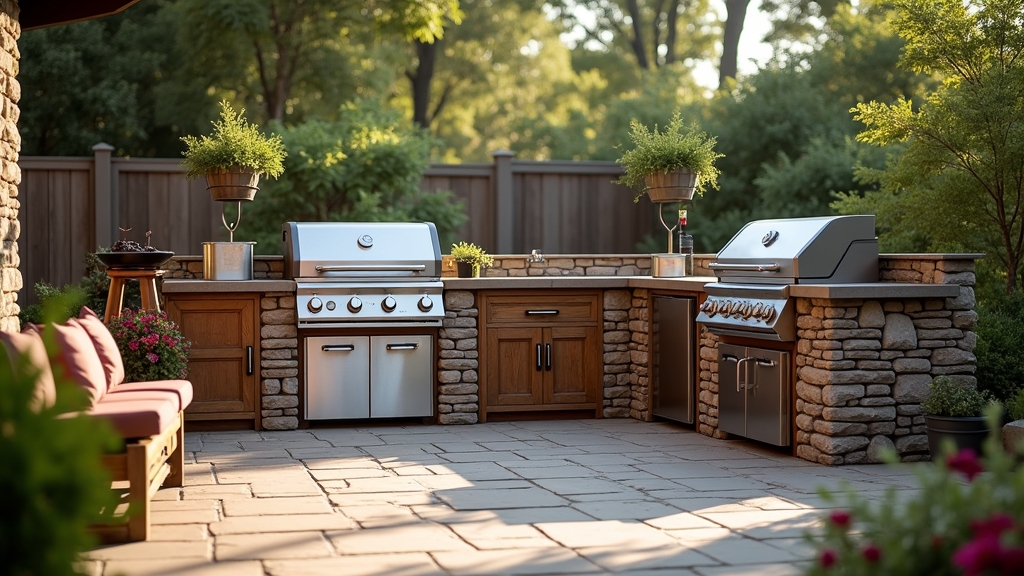
For a permanent, high-value BBQ area, custom masonry is king. This involves building a frame from concrete masonry units (CMU), wrapping it in natural stone veneer, and topping it with granite or concrete counters. What most people miss is the need for a dedicated concrete footer; you cannot build a 2,000-pound stone island directly on a standard 4-inch patio without it eventually cracking.
Pros of Custom Masonry
- Total Customization: We can build in pizza ovens, ice chests, and even trash chutes exactly where you want them.
- Longevity: Built correctly, these structures last 30+ years.
- Property Value: Real estate data consistently shows that custom outdoor kitchens offer one of the highest ROIs in landscaping.
Cons of Custom Masonry
- Cost: It is significantly more expensive due to specialized labor.
- Permitting: Most municipalities require structural and gas permits for permanent builds.
Cost Comparison Breakdown
The good news is that there is a setup for every budget, but you must account for 'invisible costs' like gas line extensions and electrical outlets. Worth mentioning: always choose 304-grade stainless steel for your components; 430-grade will rust within two seasons in humid climates.
- Standalone: $1,500 – $4,000 (Includes high-end grill and a quality prep cart).
- Prefab Island: $5,000 – $12,000 (Includes island, grill head, and basic assembly).
- Custom Masonry: $15,000 – $40,000+ (Includes footer, stone work, utilities, and high-end appliances).
Best Use Cases for Each Setup
On the other hand, if you aren't sure which way to go, consider your 'entertaining style':
- The Weekend Warrior: Go with the Standalone Cart. Your focus is on the sear and the smoke, not the hosting.
- The Family Entertainer: Choose the Prefab Island. It provides the counter space needed for buffet-style serving without the massive renovation timeline.
- The Luxury Host: Invest in Custom Masonry. You need the integrated lighting, bar seating, and plumbing to host 20+ people comfortably.
Final Recommendation
If you are looking for the best balance of longevity and cost-efficiency, I recommend the Semi-Custom Hybrid approach. Buy a high-quality 304-stainless steel grill head and have a local mason build a simple CMU frame with a natural stone veneer. Something to keep in mind: always install a 'vent panel' in your island. Gas can trap inside the cabinet structure, and without venting, it creates a serious explosion hazard. It’s a $50 part that saves your home.